

Google’s GMail AI Update: The 2026 Playbook


Outbound didn’t suddenly “stop working.”
What changed is the environment.
Gmail is entering the Gemini era — adding AI features that summarize threads, assist replies, and increasingly shape what gets attention in the inbox. At the same time, Google has made it clear that bulk senders are expected to operate with tighter standards: authentication, complaint control, and overall sending hygiene are no longer optional.
So here’s the reality in 2026:
The winners won’t be the teams with the cleverest templates. They’ll be the teams with the best execution system — and the discipline to measure what actually drives pipeline.
This post breaks down what to change now: how you send, what you send, what you measure, and how you keep deliverability stable while you scale.
What actually changed (in plain English)

1) Gmail is increasingly interpreting emails — not just delivering them
When your prospect sees an email today, they’re often seeing it through an AI layer: summaries, suggested replies, priority cues, and other features designed to reduce cognitive load.
That changes outbound in a simple way:
If your message is vague, bloated, or “salesy,” it’s easier to ignore — and easier to classify as noise.
2) Deliverability is now an operating discipline
Google’s sender guidance pushes bulk senders toward measurable standards — including spam-rate monitoring via Postmaster Tools.
When deliverability slips, you don’t just lose opens. You lose:
inbox placement
reply volume
positive replies
meetings booked
…and you often don’t realize it until the pipeline is already down.
The 2026 Outbound Execution Playbook
Step 1: Build a deliverability floor (the basics that protect everything)

Deliverability is the foundation. Without it, every improvement you make to targeting, messaging, and follow-up gets crushed by the inbox.
A. Monitor spam rate like a KPI
Spam complaints are one of the fastest ways to train inbox providers to suppress your mail. Google specifically points senders to Postmaster Tools for monitoring and guidance.
B. Confirm authentication is correct and aligned
At minimum, bulk sending requires:
SPF
DKIM
DMARC…configured correctly and aligned with your “From” domain.
This isn’t “technical nice-to-have.” It’s how you prove legitimacy at scale.
C. Make unsubscribing frictionless
When people feel trapped, they don’t unsubscribe — they report spam. Clean unsubscribe handling reduces complaint risk, and complaint risk is the metric inbox providers care about.
A simple rule for 2026:If deliverability is not measured weekly, it’s not managed.
Step 2: Change how outbound is executed (the sending behaviors that keep you out of trouble)
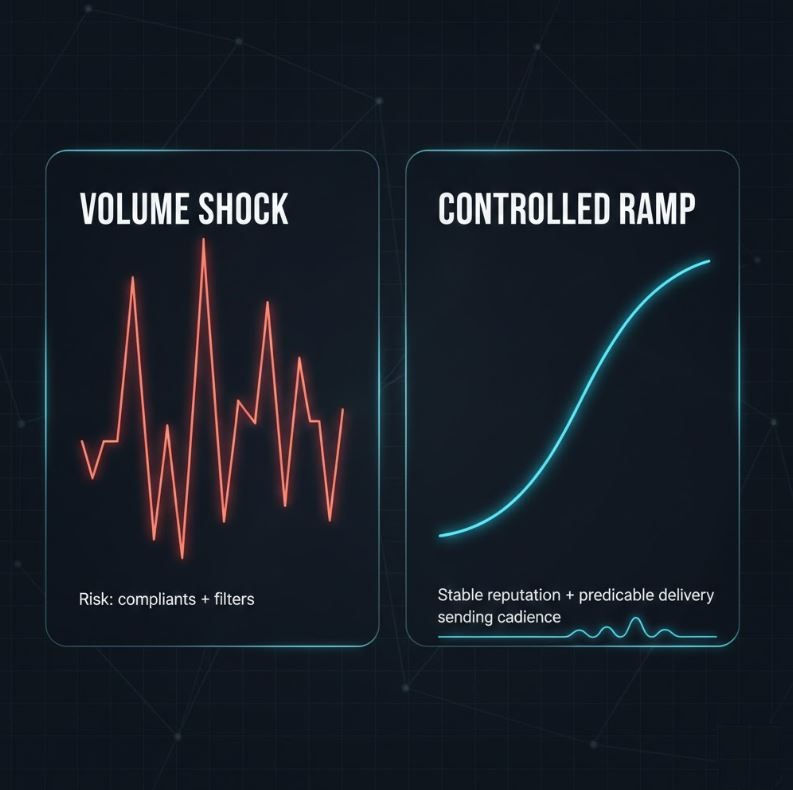
Most outbound teams hurt themselves with sending patterns that scream “bulk.”
A. Eliminate volume shock
Inbox providers notice sudden spikes. Outbound should ramp and scale deliberately:
consistent daily patterns
stable sending volume
gradual increases instead of “big blasts”
B. Micro-segment instead of blasting
One campaign to everyone is dead. The new standard is micro-campaigns built around:
a specific persona slice
a specific pain category
a specific reason the message is relevant now
Smaller, tighter segments do two things:
raise human engagement
reduce negative engagement (complaints)
That’s not a copy trick — it’s a deliverability strategy.
C. Protect your primary domain
Outbound should not put your core domain at risk. Domain and mailbox segmentation keeps risk contained and gives you room to test aggressively without burning your “real” brand.
Step 3: Change what you send (so the message is understood instantly)

In 2026, outbound writing is less about persuasion and more about clarity and relevance.
A cold email should make five things obvious almost immediately:
who it’s from
why it’s being sent
why it’s relevant to the recipient’s role
why it’s credible
what the next step is
When those answers aren’t clear, people ignore it — or worse, mark it as spam. And spam complaints compound fast.
To prevent that, optimize for:
short, readable formatting
direct language (not marketing language)
specific claims (not vague benefits)
one primary action (not multiple CTAs)
This is how outbound becomes easier for a human to process and less likely to trigger negative engagement.
Step 4: Fix list hygiene (because data quality is deliverability now)

Bad lists don’t just reduce conversion — they damage sender reputation.
In 2026, list quality impacts:
bounces
complaint probability
overall domain reputation
inbox placement stability
Minimum hygiene for modern outbound:
dedupe across campaigns and sources
suppress role accounts unless intentional
remove high-risk domains and known bouncers
keep segments clean (titles, departments, geography, industry)
This is how you protect deliverability while still driving volume.
The New Outbound Scorecard (what to measure in 2026)

If outbound is going to be operated like a system, it needs a scorecard.
The goal is simple: measure what predicts pipeline — not vanity metrics.
1) Deliverability Health (Leading Indicators)
Spam rate (Postmaster Tools)
Hard bounce rate
Unsubscribe rate
Delivered-to-sent trend
If these degrade, scaling outbound is a mistake. Fix the inputs first.
2) Human Engagement (Core KPIs)
Reply rate = replies / delivered
Positive reply rate = positive replies / delivered
Meeting rate = meetings booked / delivered
Normalize these “per 1,000 delivered” to compare segments fairly.
3) Pipeline Outcomes (What leaders actually want)
SQLs per 1,000 delivered
Pipeline $ per 1,000 delivered
Cost per meeting
Cost per SQL
This is how outbound becomes a predictable lever instead of a guessing game.
The 72-hour rollout plan
Day 1 — Compliance + instrumentation
verify SPF/DKIM/DMARC alignment
confirm unsubscribe behavior
set up deliverability monitoring (including Postmaster Tools)
Day 2 — Micro-campaign build
pick 2–3 tight segments
build clean lists per segment
write one message per segment (not one message for everyone)
Day 3 — Controlled launch + scorecard
launch small (200–500 per segment)
track spam rate, bounces, replies, positive replies, meetings
iterate targeting first, message second, volume last
Fix Deliverability Before You Scale Outbound
If Gmail is filtering harder in 2026, the fastest win is tightening the fundamentals: authentication, sending patterns, list hygiene, and complaint control.

Get a Deliverability Health Check that identifies what’s suppressing inbox placement and outlines the exact fixes to stabilize performance.


Comments